

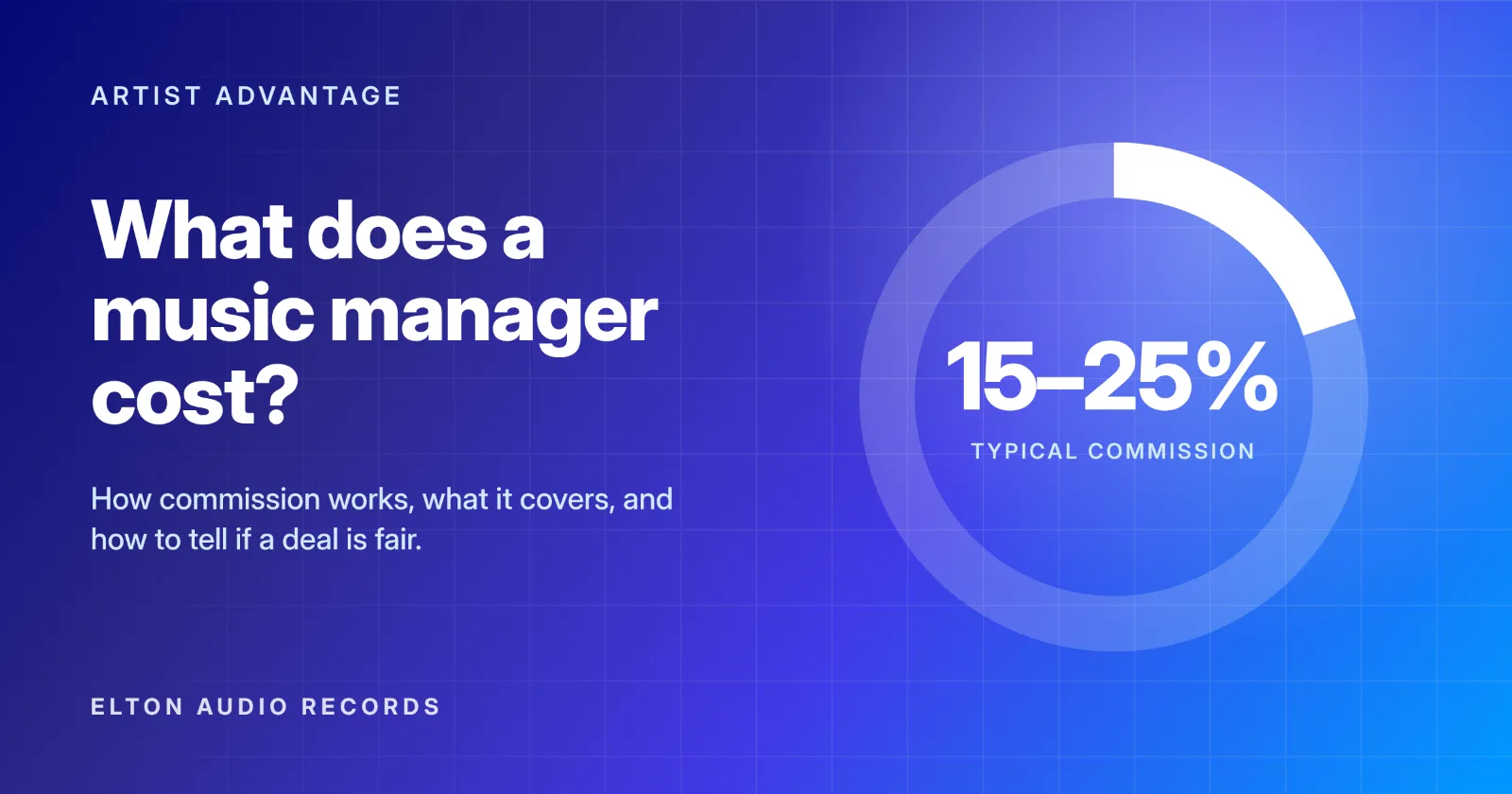
What does a music manager actually cost? Most take 15–25% of an artist's income. Learn how commission works, why it covers the whole career, and how to tell if a deal is fair.
One of the first questions artists ask about management is what it will cost them. It is a fair question, and the answer is simpler than most people expect. Most managers are paid a percentage of what the artist earns, which ties the manager's income directly to the artist's growth.
The short answer: most music managers take between 15% and 25% of an artist's income. 20% is common for developing artists. Some managers charge 25% to 35%, and a rate as low as 10% is rare, usually reserved for very large touring acts where the income is high enough to support it.
Why do artist manager fees vary?
No two managers do the same job, so no two rates mean exactly the same thing. The number usually depends on how much work the manager is taking on and what they bring with them. A manager guiding an established act with a full team in place may take a smaller share. A manager building a career from the ground up is doing far more of the work, and usually takes more. At EAR, our management commission starts at 20%. Alongside management, we are able to offer our artists strategy, infrastructure, release planning, business development, negotiation and partnerships, as well as label services that range from distribution to a publishing division.
We do not believe higher rates are necessary for most artists. When a manager asks for 30% or more, it is worth asking what the artist gains in return.
How does manager commission work?
Commission is a percentage taken from the income the agreement covers. If an artist earns $5,000 in a month and their manager's commission is 20%, the artist keeps $4000.
The artist's own costs and taxes come out of their share afterward. The calculation is simple. What takes more attention is which income the agreement covers, which the next sections explain.
Does a manager take commission on income the artist already had?
A manager's job is not to work on one album or one tour. It is to move the entire career forward. That is why most management agreements apply commission to all of the artist's music income, including income and deals that were already in place when the manager arrived.
Think about it from the manager's side. If an artist is earning $100,000 a year and the manager is excluded from all of it, a 20% commission is effectively 0%. The manager would be working full time to grow a career while earning nothing from the career itself. Some managers negotiate different terms for existing income, but artists should understand why a manager expects to share in the whole picture: they are now responsible for protecting and growing it.
"A manager is not hired to work on one release. They are hired to move the entire career forward."
Is commission taken from gross or net income?
Commission is usually calculated on gross income, meaning the total the artist earns before their own personal costs. There is a common exception for money that only passes through the artist on its way to someone else. On a show, for example, the venue's cut, payments to support acts and fees paid to hired musicians who are not members of the band are typically not counted. If a show pays $3,000 and $500 of that goes to the support act, commission is usually calculated on the remaining $2,500. The artist never truly earned that $500, so the manager does not commission it. Every agreement should spell out exactly how this works.
Do music managers charge upfront or monthly fees?
A percentage of very little is very little. When an artist has no meaningful income, a manager may spend months working without being paid. Because of that, it is common for managers working with earlier-stage artists to charge an upfront fee or a monthly retainer to cover their time. This is not a red flag on its own. What matters is that the fee is clearly defined, the scope of work is in writing, and the artist understands how the arrangement changes once the music starts earning.
How long does a manager receive commission?
Most management agreements run for a set term, with options to renew. Many also include a sunset clause, which lets the manager keep earning a reduced commission on work they helped create for a limited time after the agreement ends. Sunset clauses are standard and reasonable, because a manager may spend a year building something that pays out after they are gone. The period and the percentage should be clearly defined, and the commission should step down over time rather than continue forever.
Are expenses included in the commission?
Managers sometimes spend money on an artist's behalf, such as travel to a show or an ad campaign. In most agreements those costs are reimbursed separately from commission, and larger expenses should require the artist's approval first. Artists should expect clear records of what was spent and why.
Who else on an artist's team takes a percentage?
A manager is not a booking agent, a lawyer, a promoter or an advertiser, although a good manager coordinates all of them. Each role is paid differently, and some take their own percentage. Understanding who does what helps an artist see what they will actually keep.
What are the red flags in a management deal?
Be cautious of a manager who will not put terms in writing, charges fees with no defined scope, or locks an artist into a long agreement with no clear way out. A manager who guarantees specific results, such as a label deal or a set number of streams, should also raise questions. Setting big goals together is part of good management; promising outcomes no one controls is not. Good management is built on clear terms and shared goals.
What if I am not ready for a manager yet?
Management works best when there is already something to manage: released music, a growing audience and some momentum. Artists who are still shaping their sound, building a catalog or defining their brand often get more from artist development first. Development builds the foundation, so that management has something to grow when the time comes. We explain the difference in Artist Development vs. Management, and cover what managers look for in What Artist Managers Actually Expect From Artists.
Is a music manager worth the cost?
The percentage matters, but it is rarely the deciding factor. A manager who takes 20% and doubles an artist's income is worth far more than one who takes 15% and changes nothing. The better question is whether the manager has a clear plan, communicates consistently, and is invested in where the career is going. If you are still deciding whether management is right for you, read Do You Really Need an Artist Manager?
Ready for management? Apply to EAR and start with a free 90-day trial run to see how the relationship works before committing.
Still building your foundation? Learn about EAR Artist Development.
Frequently asked questions
How much does a music manager cost? Most managers take 15% to 25% of an artist's income. 20% is common for developing artists.
Do managers take commission on income an artist already had? Usually yes. Most agreements cover all music income, because the manager becomes responsible for the whole career. Some managers negotiate different terms.
Do artist managers charge upfront or monthly fees? Sometimes. When an artist is not earning yet, managers commonly charge an upfront fee or monthly retainer to cover their time.
Is commission taken from gross or net income? Usually gross, with exceptions for money that passes through to others, such as the venue's cut or payments to support acts and hired musicians.
Is 20% too much for a manager? Not for a developing artist. What matters more is whether the manager has a real plan to grow the income the percentage comes from.