
As a music career grows, the list of people involved grows with it. Managers, booking agents, lawyers, promoters, publicists, publishers, distributors and labels all play a part, and many of them want a percentage. Knowing who does what helps an artist build the right team in the right order, and avoid paying for help they are not ready to use.
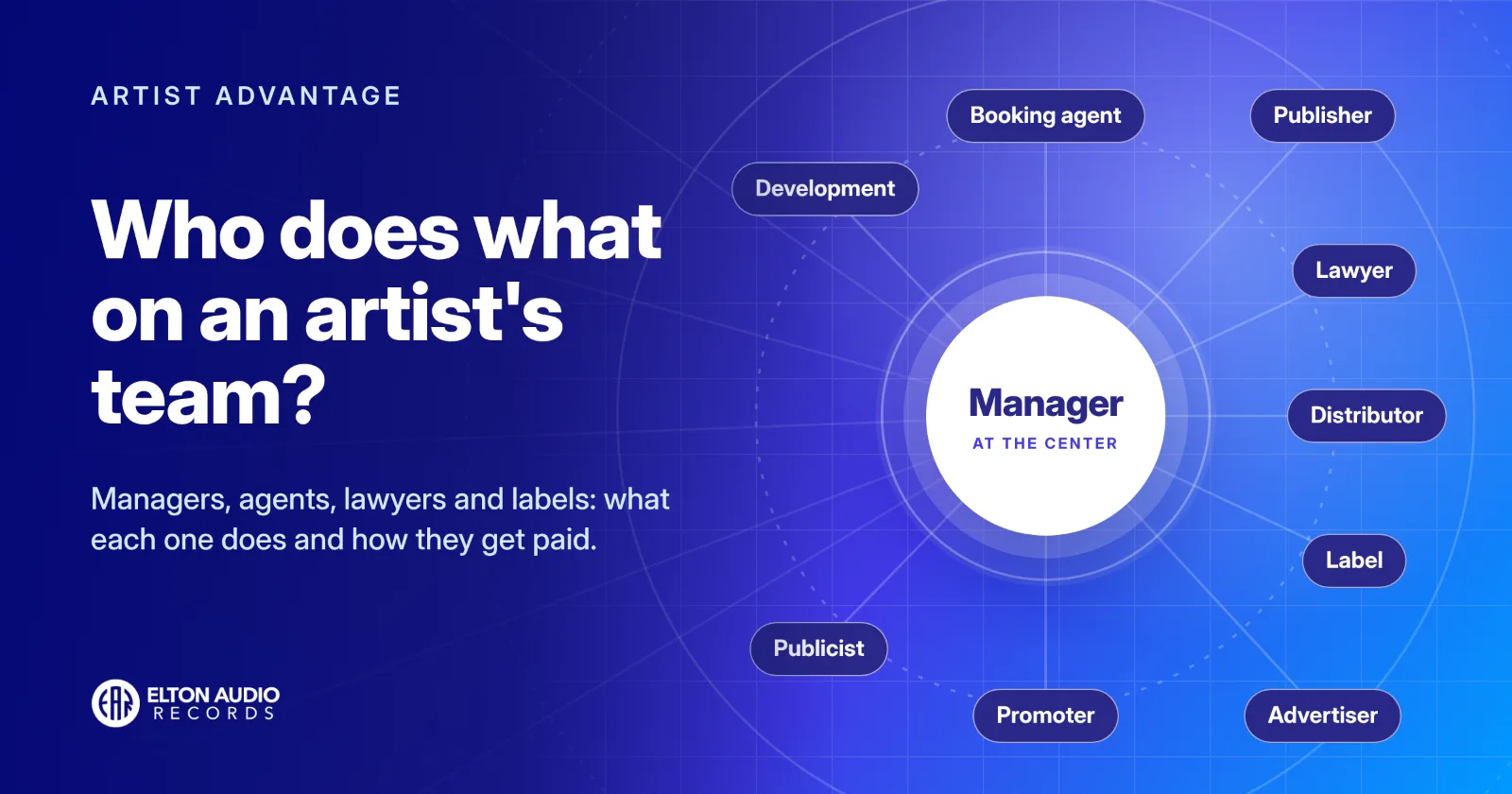
The short answer: the manager runs the business and coordinates everyone else. Development builds the foundation before there is much income. Booking agents get shows, promoters and publicists get attention, lawyers protect the deals, business managers handle the money, and publishers, distributors and labels handle the music itself. Most of these roles are paid a percentage, which only works once the artist is already earning.
Who does what at a glance
- Artist manager: runs the career and coordinates the team. Usually a percentage of income, often 15–25%. Needed once there is momentum and some income.
- Development: builds sound, image, brand and first assets. Usually a program or project fee. Needed before there is meaningful income.
- Booking agent: books shows and negotiates performance fees. Around 10% of show income, sometimes plus a fee at the lower end. Needed once you can sell tickets.
- Concert promoter: puts on and markets a specific show. Takes a share of ticket revenue after costs. Involved in every show, through the venue or agent.
- Music promoter: pitches songs to radio, playlists or press. Usually a per-campaign fee. Needed around releases.
- Publicist: gets press coverage and manages image. Usually a monthly retainer. Needed when there is a story worth covering.
- Advertiser: runs paid ads to grow listeners and fans. An ad budget plus a service fee. Needed when the music and content are ready to scale.
- Music lawyer: reviews and negotiates contracts. Hourly or a percentage of a deal. Needed before signing anything significant.
- Business manager: handles accounting, taxes and money. Around 5% of income, or a monthly fee. Needed once income gets complicated.
- Publisher: collects and grows songwriting income. A share of publishing income. Needed once songs are earning or getting placed.
- Distributor: delivers music to streaming stores. A yearly fee or a small share of revenue. Needed from the first release.
- Label: funds, releases and markets music. A share of master income, often with an advance. Needed when a deal adds something the team does not have.
Why a percentage only works when there is income
Before looking at each role, one point matters more than any other. A percentage means a person earns a share of money the artist is already making. Ten percent of nothing is nothing. If an artist has no revenue yet, a professional working on percentage has no way to be paid for their time, and is usually not the right fit at that stage. That is why many people at the earlier end of the industry charge a set-up fee, a retainer or a project fee instead of, or alongside, a percentage. It is not a scam. It is simply how anyone gets paid for work done before the income exists.
What does an artist manager do?
The manager is the center of the business. They set the strategy, plan releases, make introductions, negotiate opportunities and coordinate everyone else on this list. When a booking agent, label or publisher joins the team, the manager is the one making sure each of them is pulling in the same direction. Managers are usually paid a percentage of the artist's income, commonly 15% to 25%. We explain how that works in How Much Does a Music Manager Cost?.
At EAR, management covers more of this list than most artists expect. Alongside strategy, we are able to help with early booking, marketing and promotion, and much of the contract work, while bringing in a lawyer or other specialist when a deal calls for it.
What is artist development?
Development is the structure and strategy that helps an artist reach their potential, both artistically and on the business side. It is where an artist figures out their image, their sound and what sets them apart. It is often where the first records are cut, vocals are trained, the first photoshoot happens, and the first music video and marketing materials are made. It is what makes up the first EPK and the first shows that get things moving.
Development is for artists who are pre-revenue or earning a small amount. Its job is to set the stage for a manager to come in next and scale what is already working.
Development is also where artists should be the most careful with their money. Specialized development companies can charge a great deal. We have seen packages range from $30,000 to $100,000. The services can look similar across development companies, music education programs, small labels and recording studios, so the best advice is to shop around, do not get caught up in name dropping, and ask what comes after the program ends. At EAR, development is priced per artist and typically comes in well under $10,000 all in, including producer and other costs. We only take on development artists we see real potential in, and the program is built to lead into management.
What does a booking agent do?
A booking agent finds and books shows, negotiates performance fees and routes tours. Agents are commonly paid around 10% of show income. At the lower end of the market, many agents also charge a set-up fee or a recurring retainer, because a percentage of a small guarantee does not cover their time. Larger agencies tend to work strictly on percentage, which is also why they look for artists with a history of selling tickets.
If an artist has no live history and is not yet earning from shows, there is little reason to give away 10% of nothing. More importantly, a booking agent cannot fix a band that cannot sell tickets. Getting people to a show is a marketing problem, and that is where a manager can help. The usual path is for a manager to help with early booking and build a draw, then bring in an agent to scale it.
What is the difference between a concert promoter and a music promoter?
The word promoter means two different jobs. A concert promoter puts on a show. They book the venue, cover costs and market the event, then share ticket revenue with the artist after expenses. Artists usually deal with concert promoters through a booking agent or the venue.
A music promoter pitches songs to people who can play or feature them: radio stations, playlist curators, blogs and press. They are usually paid a fee per campaign. A good promoter is clear about who they are pitching to and never guarantees placements, plays or streams.
What does a publicist do?
A publicist secures press coverage, interviews and features, and helps shape how an artist is presented in public. Publicists are commonly paid a monthly retainer for a set campaign. Press works best when there is a real story to tell, such as a significant release, a tour or a milestone, so a publicist is usually more valuable a little later in a career than artists expect.
What does a music advertiser do?
Advertising is paid promotion: ads on Instagram, Facebook, TikTok and YouTube, aimed at growing listeners and turning them into fans. It is usually paid as an ad budget plus a service fee for running the campaigns. Ads scale what is already working. They will not fix music or content that is not connecting. EAR is able to help with Meta ads and playlist campaigns as part of a wider release strategy.
When do you need a music lawyer?
A music lawyer reviews and negotiates contracts: management agreements, label deals, publishing deals and anything else with long-term consequences. Lawyers usually bill hourly or take a percentage of a specific deal. An artist does not need a lawyer on retainer early on, but should have one review anything significant before signing. A manager can handle much of the everyday contract work and recognize when something needs a lawyer.
What does a business manager do?
A business manager handles the money: accounting, taxes, budgets, payroll and investments. They are commonly paid around 5% of income or a monthly fee. Most independent artists do not need one until their income and expenses become complicated, such as when touring with a crew or running several revenue streams.
What does a music publisher do?
A publisher works on behalf of the songs, not the recordings. They register compositions, collect songwriting royalties from around the world, and pitch songs for sync placements in film, TV and advertising. Publishers take a share of publishing income, and the size of that share depends on the type of deal. EAR runs publishing in house through Elton Audio Publishing.
What does a music distributor do?
A distributor delivers releases to Spotify, Apple Music and other stores, collects the revenue and pays it out. Distribution is usually paid through a yearly fee or a small share of revenue. Every releasing artist needs one from day one. Distribution is included with EAR management.
What does a record label do, and what kind of deal is fair?
Labels fund, release and market recorded music, but label deals vary widely. A distribution deal delivers the music and takes a smaller share, with the artist keeping most of the income. A traditional deal usually pays an advance and covers recording and marketing costs, which are recouped from the artist's share, and the label keeps the larger share of master income.
A third kind of deal has become very common. A label offers to set up the release strategy, handle distribution and give feedback on the music, art and content, and asks for 50% in return. That work is the job of management. If an artist already has a manager, giving away half of their income for work their team already does makes little sense.
In our view, the manager is the center of the business, not the label. When a label wants to work with an artist who is already managed, the label should multiply what is already working. That usually means an advance, real marketing spend, or a tool or advantage the team does not already have. Be especially careful with promises. We have seen labels promise editorial playlist support and hundreds of thousands of streams in exchange for 50% of a release, without putting any of it in writing. If a promise matters to the deal, it belongs in the contract.
"A label should multiply what is already working, not take half of it for work the team already does."
In what order should an artist build their team?
Most careers follow a similar order. Development comes first, building the sound, image and first assets while income is small. A distributor is needed from the first release. A manager comes in once there is momentum, to build the business and scale what is working. Booking agents, publicists, business managers and labels follow as the career creates real demand for them. A lawyer should be on call whenever a significant contract appears.
Skipping steps is expensive. A booking agent cannot sell tickets for a band no one knows, and a label deal signed too early can cost far more than it brings in.
Ready for management? Apply to EAR and start with a free 90-day trial run.
Still building your foundation? Learn about EAR Artist Development.
Frequently asked questions
What is the difference between a manager and a booking agent?
A manager runs the whole career and coordinates the team. A booking agent focuses only on getting shows and negotiating performance fees.
How much does a booking agent take?
Commonly around 10% of show income. Agents working with newer artists may also charge a set-up fee or retainer.
Do I need a booking agent if I am not making money from shows yet?
Usually not. An agent cannot fix low ticket sales. Building a draw first, often with a manager's help, makes an agent far more useful later.
How much does artist development cost?
It varies widely. Specialized development companies can charge $30,000 to $100,000. Compare what each program includes and what happens after it ends.
Is a 50% label deal fair?
It depends on what the label adds. If it only provides release strategy and distribution that a manager already handles, 50% is hard to justify. An advance, real marketing spend or something the team cannot do itself changes that.